Truck & Car Guides / Record-breakers & famous machines
Giant machines of mining and industry
Meet the biggest wheeled and tracked machines ever built, from 450-tonne haul trucks to bucket-wheel excavators longer than a football field, and learn why they are so big.
Why build machines this big?
In open-pit mining, the cost of moving each tonne of rock is everything. One huge truck with one driver can carry as much as several smaller trucks, so mines have pushed machine sizes higher for decades. Bigger loaders and excavators fill those trucks in fewer passes. The result is a class of machines so large that they cannot drive on public roads and are delivered in pieces, then assembled on site.
The biggest haul trucks
Ultra-class haul trucks are the giants of mining. They carry hundreds of tonnes of rock out of open pits on wide haul roads built just for them.
| Truck | Maker | Rated payload | Notable for |
|---|---|---|---|
| BelAZ 75710 | BelAZ (Belarus) | About 450 tonnes | Largest-capacity haul truck, introduced in 2013; eight tires, two diesel engines, electric drive |
| Caterpillar 797F | Caterpillar (USA) | About 400 short tons | One of the best-selling ultra-class trucks |
| Liebherr T 284 | Liebherr | About 400 short tons | Diesel-electric drive |
| Komatsu 980E | Komatsu (Japan) | About 400 short tons | Diesel-electric ultra-class truck |
Most of these use diesel-electric drive: a huge diesel engine turns a generator, and electric motors in the wheels move the truck. It is the same idea used in railway locomotives. Their tires alone can stand around twice the height of an adult. See diesel engine basics.
Bucket-wheel excavators
The heaviest land vehicles ever built are the bucket-wheel excavators used in German open-pit lignite mines. Bagger 293, built by TAKRAF, is often cited as the heaviest, at around 14,000 tonnes. These machines are around 220 meters (720 feet) long and close to 100 meters tall. A giant rotating wheel lined with buckets cuts into the ground, and conveyor belts carry the material away. They move very slowly on crawler tracks, at well under 1 kilometer per hour.
Draglines
Walking draglines drag a huge bucket across the ground with cables to remove soil above coal seams. The most famous was Big Muskie, which worked in Ohio from 1969 to 1991 and had a bucket big enough to hold a couple of buses. It was dismantled in 1999, though its bucket is preserved as a display.
Moving rockets: the crawler-transporters
NASA's two crawler-transporters, built in the 1960s, carry rockets and their launch platforms from the Vehicle Assembly Building to the launch pads at Kennedy Space Center in Florida. Each weighs roughly 2,700 tonnes and travels at about 1 mile per hour when loaded. They have been upgraded over the years to carry heavier modern rockets.
Road trains of Australia
On public roads, Australia's road trains hold the records for length. In remote parts of the country, a single prime mover may pull three or four trailers, with combinations well over 50 meters long on approved routes. They haul cattle, fuel and freight across huge distances where rail is not available. Rules on lengths and routes vary by state and territory.
Heavy haul on US roads
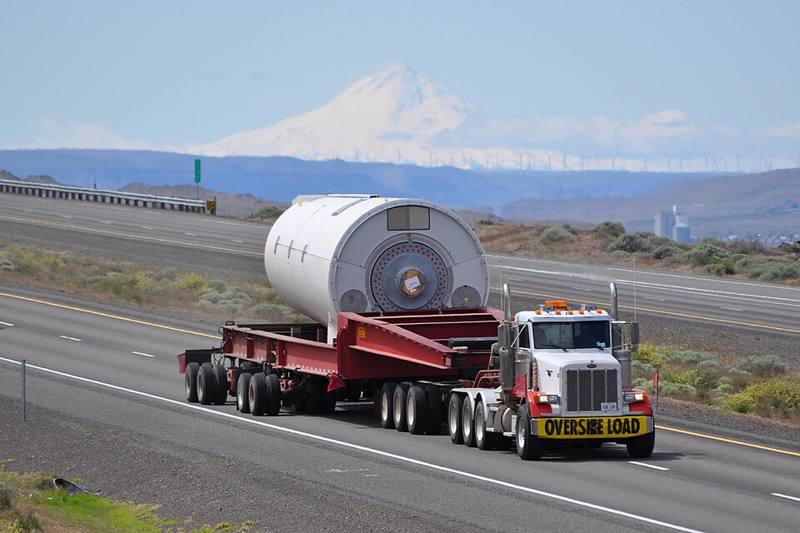
In the US, extremely heavy items such as transformers, wind turbine parts and industrial vessels move on multi-axle trailers with special permits, escorts and planned routes. Some loads move at night or require temporary removal of signs and power lines. See oversize and heavy haul.
Many giant mining trucks can now operate autonomously, guided by GPS and sensors, in mines in Australia, the Americas and elsewhere.