Truck & Car Guides / Road safety
Sharing the road with big trucks
Truck blind spots (the No-Zones), why trucks make wide turns, how to pass safely, and the simple habits that keep car drivers and truck drivers out of each other's way.
Why it matters
A loaded tractor-trailer can weigh up to 80,000 pounds on US interstates, roughly 20 times the weight of a typical car. It needs much more room to stop, turn and change lanes, and the driver sits high up with large blind spots. Most crashes between cars and trucks happen in a handful of predictable situations. Knowing them is the best protection for everyone.
General education only. Follow your state's driver handbook, posted signs and local laws.
The No-Zones: truck blind spots
The FMCSA calls the large blind spots around a truck the No-Zones. A simple rule: if you cannot see the truck driver's face in their side mirror, they cannot see you.
| No-Zone | Where it is | Why it is dangerous |
|---|---|---|
| Front | Directly in front of the cab, roughly 20 feet | The driver looks over the hood and cannot see a car that cuts in close |
| Rear | Directly behind the trailer, roughly 30 feet | No rear-view mirror; you also cannot see traffic ahead |
| Left side | Alongside the cab and trailer, below the driver's mirror | Smaller than the right side but still large |
| Right side | Alongside the cab and back along the trailer, often spanning more than one lane | The largest blind spot; the most dangerous place to linger |
Passing a truck safely
- Pass on the left whenever possible. The left-side blind spot is smaller.
- Pass steadily. Do not cruise alongside a truck; move through the side No-Zone without lingering.
- Wait to merge back until you can see the whole front of the truck, both headlights, in your rear-view mirror.
- Do not slow down right after cutting in front. A truck cannot stop as quickly as a car; see stopping distances.
Wide turns
Trailers do not follow the exact path of the cab. On a turn, the trailer wheels track inside the cab's path, a behavior called off-tracking. To make a right turn without the trailer climbing the curb, truck drivers often swing left first or start the turn from the second lane.
- Never try to squeeze into the gap on the right of a truck that is turning right.
- Stop behind the stop line at intersections so trucks have room to swing through.
- Watch for signs on trailers such as "This truck makes wide right turns."
Following and stopping
- Leave extra space behind a truck: you need to see around it, and debris or tire fragments can come off.
- Do not stop too close behind a truck on a hill; it may roll back slightly when starting.
- Give space when a truck is backing, and never cut behind a reversing truck.
Tips for truck drivers
- Signal early and check mirrors often, especially before lane changes to the right.
- Keep a large following distance and look far ahead.
- Use the right lane on long grades and be patient with merging traffic.
- Take extra care around work zones, where many serious truck crashes occur.
Special situations
Merging onto highways. Match the speed of traffic and do not force your way in front of a truck. Truck drivers often move left to make room when they can, but they cannot always.
Bad weather. Trucks throw up a lot of spray. Give more space and turn on your headlights. See winter driving.
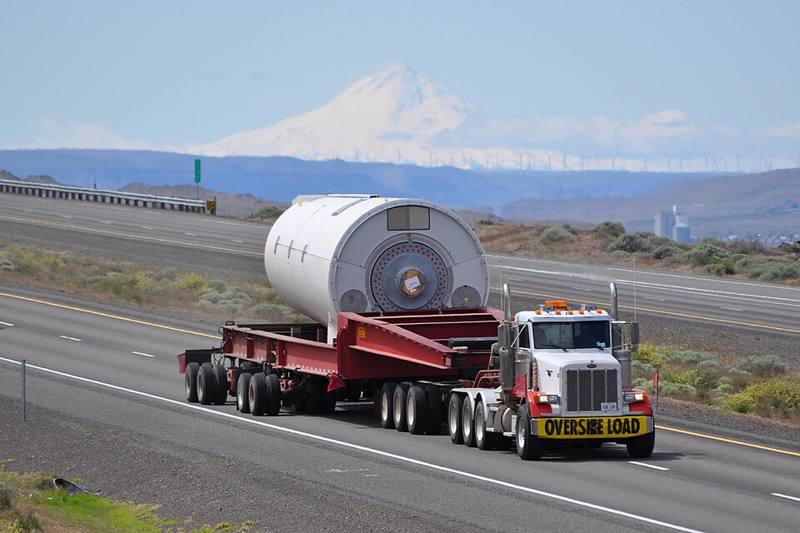
Oversize loads. Escort vehicles and wide loads need extra space; follow escort directions. See oversize and heavy haul.
Make eye contact through the truck's mirror. If you can see the driver, you have a good chance they can see you.