Truck & Car Guides / Trucks explained
Semi truck anatomy, part by part
A tractor-trailer is two vehicles joined at a single pin. Here is what every major part does, from the steer axle to the trailer's landing gear.
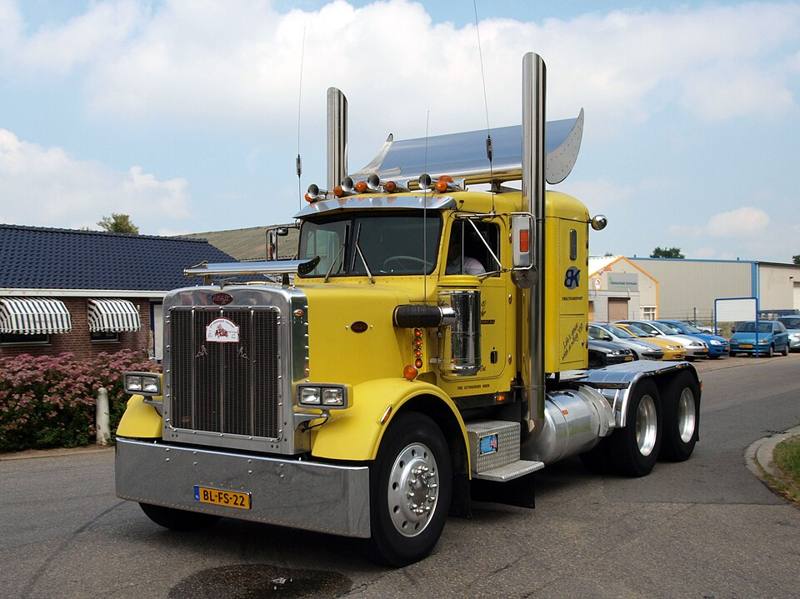
Two vehicles, one rig
In North America a "semi" or "18-wheeler" is really two vehicles. The tractor (also called the power unit) holds the engine, cab and drive axles. The semi-trailer carries the cargo and has axles only at the rear. Its front end rests on the tractor, which is why it is called a semi-trailer: it cannot stand level on its own wheels.
The classic count of 18 wheels comes from a three-axle tractor (2 steer tires plus 8 drive tires) and a two-axle trailer (8 tires). Many trucks today use single wide tires in place of duals, so not every 18-wheeler actually has 18 tires.
The tractor
- Cab: the driver's workspace. A day cab has seats only; a sleeper cab adds a bunk behind the seats. See sleeper vs day cab.
- Engine: usually a large inline-six diesel. Long-haul Class 8 tractors commonly use engines of roughly 13 to 15 liters. Learn more in diesel engine basics.
- Transmission: a manual gearbox with 10, 13 or 18 speeds, or, more often today, an automated manual. See truck transmissions.
- Steer axle: the front axle, which turns the truck. It carries most of the engine weight.
- Drive axles: usually two powered axles in a tandem at the rear of the tractor. A tandem spreads weight and gives traction.
- Fuel tanks: saddle tanks mounted on the frame rails. Long-haul trucks often carry a combined 200 gallons or more.
- Air system: a compressor, air tanks and lines that run the brakes, suspension and other accessories. See air brakes.
- Aftertreatment: a diesel particulate filter, a selective catalytic reduction unit and a tank of diesel exhaust fluid (DEF) that clean the exhaust on modern engines.
The connection: fifth wheel and kingpin
The fifth wheel is the heavy, horseshoe-shaped plate on the back of the tractor. Under the front of the trailer is a steel pin called the kingpin. When the tractor backs under the trailer, the kingpin slides into the fifth wheel and locking jaws close around it. The trailer pivots on that pin when the truck turns.
Most fifth wheels can slide forward or back on a rail. Moving it shifts weight between the steer axle and the drive axles, which is one tool drivers use to stay within axle weight limits.
Two more connections run between tractor and trailer:
- Gladhands: couplers for the two air lines. The service line (usually blue) carries the brake signal; the emergency or supply line (usually red) charges the trailer's air tanks and holds its spring brakes off.
- Electrical cord: a seven-way plug that powers the trailer lights and the trailer's anti-lock braking system.
The trailer
- Landing gear: two legs near the front that hold the trailer up when it is not coupled. Drivers crank them down before unhooking.
- Trailer tandem: the rear axle group. On many vans it slides along the frame, so drivers can move weight between the tractor's drives and the trailer's axles.
- Rear impact guard: the steel bar across the back that helps keep cars from sliding under the trailer in a rear crash.
- Mud flaps, lights and reflective tape: required equipment that makes the trailer visible and protects following traffic from spray and rocks.
How the pieces work together
When the driver presses the brake pedal, air pressure travels down the service line to brake chambers at every wheel. When the engine pulls, torque flows through the transmission and driveshafts to the drive axles, which push the fifth wheel, which pulls the kingpin and the whole trailer. Everything is designed around one goal: moving a heavy, long load safely and legally.
The best way to learn the parts is a real pre-trip inspection. CDL students walk around the truck naming and checking each component.
Quick reference table
| Part | Where it is | What it does |
|---|---|---|
| Steer axle | Front of tractor | Steers, carries engine weight |
| Drive tandem | Rear of tractor | Puts power to the road |
| Fifth wheel | Top rear of tractor frame | Couples to the kingpin |
| Kingpin | Under the trailer nose | The pivot the trailer turns on |
| Gladhands | Back of cab and front of trailer | Connect the air lines |
| Landing gear | Front third of trailer | Supports an uncoupled trailer |
| Trailer tandem | Rear of trailer | Carries the rear of the load |