Truck & Car Guides / Trucks explained
How air brakes work
Heavy trucks stop with compressed air, not brake fluid. Here is how the compressor, tanks, chambers and spring brakes work together, and why the system fails safe.
Why air instead of hydraulics
Cars use hydraulic brakes: pressing the pedal pushes fluid through sealed lines. On a tractor-trailer, the brakes are spread over five or more axles and two separate vehicles that couple and uncouple many times a day. Compressed air solves that problem. Air is free, a small leak does not drain a reservoir of special fluid, and lines can be connected and disconnected quickly with gladhands. George Westinghouse developed the air brake for railroads in the 1860s, and the same basic idea now stops almost every heavy truck and bus.
The main parts
- Compressor: driven by the engine, it pumps air into the tanks.
- Governor: controls the compressor. On many trucks it stops pumping ("cut-out") at around 120 to 135 psi and starts again ("cut-in") at roughly 100 psi. Check your vehicle's specifications.
- Air dryer: removes water and oil from the air so lines do not freeze or corrode.
- Air tanks (reservoirs): store the compressed air. Drain valves let drivers remove moisture.
- Foot valve (treadle): the brake pedal. Pressing it sends air to the brakes in proportion to how hard you press.
- Brake chambers: round canisters at each wheel. Air pushes a diaphragm, which pushes a pushrod.
- Slack adjusters: levers connecting the pushrod to the brake camshaft. Most are now automatic.
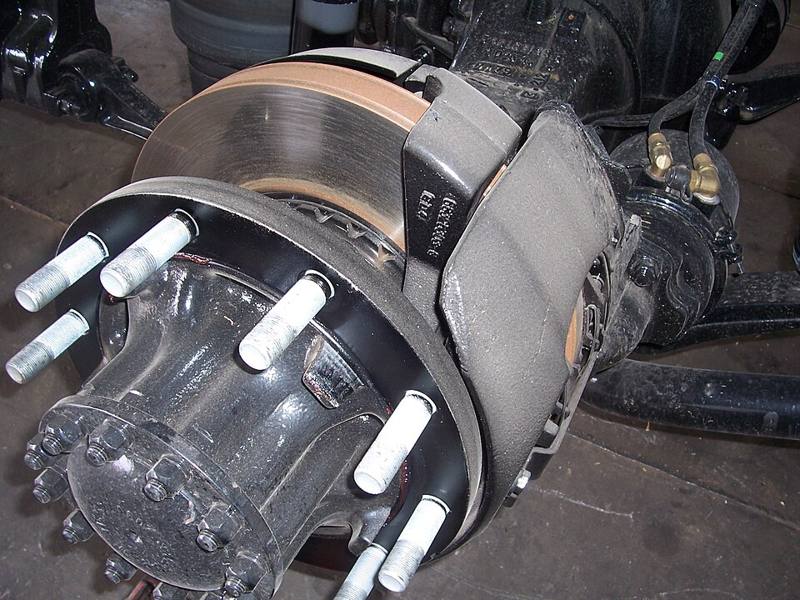
- S-cam drum brakes or air disc brakes: the parts that actually create friction. On drum brakes, an S-shaped cam spreads the shoes against the drum.
Service, parking and emergency brakes
Trucks have three braking functions in one system:
- Service brakes are applied with air pressure whenever you press the pedal.
- Parking brakes are powerful springs in the rear brake chambers. Air pressure holds those springs back. When you pull the yellow parking brake knob, air is released and the springs apply the brakes.
- Emergency braking happens automatically if air pressure drops too low. As pressure falls, the springs begin to apply on their own. That is why air brakes are described as fail-safe: a major leak stops the truck instead of leaving it without brakes.
The red trailer air supply knob does the same job for the trailer: push it in to charge the trailer and release its spring brakes, pull it out to apply them.
Warning systems
A low air pressure warning, usually a light and buzzer, must come on before pressure falls below 60 psi. If you see it, stop safely as soon as possible, because the spring brakes may soon apply on their own.
Brake lag and stopping distance
Air takes a moment to travel through the lines. This brake lag adds distance before the brakes bite, especially at the back of a long trailer. Combined with the weight of a loaded truck, it is one reason trucks need far more room to stop than cars. See stopping distances.
Brake fade
Brakes turn motion into heat. On a long downgrade, constant braking can overheat drums until they expand away from the shoes and lose grip, called brake fade. The cure is to go down in a lower gear, use the engine brake, and use steady, moderate braking only as needed. Runaway truck ramps exist for when that fails; see runaway truck ramps.
Air brake checks
CDL applicants must pass a knowledge test on air brakes and demonstrate checks during the pre-trip inspection. Typical checks include:
- Air pressure builds within the time the manufacturer specifies.
- The governor cuts out and cuts in at the right pressures.
- With the engine off and brakes applied, pressure does not leak down faster than the allowed rate.
- The low-air warning comes on before 60 psi.
- The spring brakes pop on as pressure is fanned down.
- Slack adjusters are within adjustment limits.
Testing procedures and limits come from your state CDL manual and the vehicle maker. This guide explains concepts only. If you have never been trained on air brakes, do not adjust or work on them.
Quick comparison
| Hydraulic brakes | Air brakes | |
|---|---|---|
| Medium | Brake fluid | Compressed air |
| Typical vehicles | Cars, pickups, light trucks | Heavy trucks, trailers, buses |
| Failure mode | Pedal may sink, braking lost | Spring brakes apply automatically |
| Coupling trailers | Difficult | Quick gladhand connections |
| Lag | Very small | Noticeable, especially on long rigs |