Truck & Car Guides / Trailers & loads
Cargo securement basics
The physics and the general rules behind tying down a load, from how many straps a piece of freight needs to how often drivers must check them.
The physics
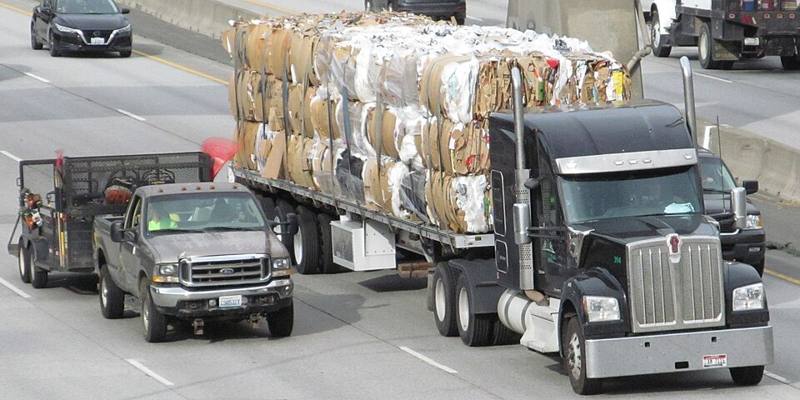
Freight wants to keep moving when the truck changes speed or direction. Hard braking throws the load forward; acceleration and bumps push it back; curves push it sideways. Securement has to hold against all of these.
US federal cargo securement rules, written by the FMCSA, set performance standards that a securement system must withstand. In general terms, the system must hold the cargo against forces equal to:
- 0.8 g decelerating forward (hard braking)
- 0.5 g accelerating rearward
- 0.5 g to either side
"g" here means a force equal to the cargo's own weight. So a system must resist a forward push of 80 percent of the cargo's weight.
Working load limit
Every chain, strap, binder and anchor point has a working load limit (WLL): the maximum load it is rated to carry in normal service. Tiedowns are marked with their WLL or have a default value set by the rules. Two key ideas:
- A system is only as strong as its weakest part. A strong chain on a weak anchor point has the anchor's rating.
- The aggregate WLL of all tiedowns must be at least half the weight of the cargo.
How many tiedowns
For articles not blocked at the front by a headerboard or other cargo, the federal rules set a minimum count based on length and weight. In general:
| Article | Minimum tiedowns |
|---|---|
| 5 ft or shorter and 1,100 lb or lighter | 1 |
| 5 ft or shorter and over 1,100 lb | 2 |
| Over 5 ft up to 10 ft, any weight | 2 |
| Over 10 ft | 2, plus 1 for each additional 10 ft or part of 10 ft |
These are minimums. The aggregate WLL rule still applies, so heavy loads often need more tiedowns than the count alone suggests. Specific commodities such as logs, metal coils, heavy machinery, concrete pipe and cars have their own detailed rules.
Ways to secure cargo
- Tiedowns: chains with binders, synthetic straps with winches or ratchets, wire rope.
- Blocking: solid pieces placed against cargo to stop it sliding.
- Bracing: pieces that push between cargo and the trailer structure.
- Friction mats: rubber mats that increase friction between cargo and deck.
- Load bars and straps: inside vans, to hold pallets in place.
- Dunnage and airbags: fill gaps so cargo cannot shift.
- Edge protectors: stop straps from being cut by sharp edges and protect the cargo.
Checking during the trip
Under the federal rules, a driver generally must:
- Inspect the cargo and its securement before the trip.
- Re-inspect within the first 50 miles and adjust as needed.
- Re-check periodically after that, generally whenever the driver's duty status changes, or after 3 hours or 150 miles of driving, whichever comes first.
Sealed van loads that the driver was told not to open are handled differently, but the driver still checks what is accessible.
Straps loosen as loads settle and as nylon stretches in the rain. A chain binder handle can snap back with great force when released. Stand to the side and keep a firm grip.
The official rules
The federal standards are in Title 49 of the Code of Federal Regulations, Part 393, sections 393.100 to 393.136. The FMCSA publishes a free Driver's Handbook on Cargo Securement with diagrams. States and Canadian provinces follow very similar rules. This guide is a summary only; always rely on the current official text and your carrier's procedures.
Common mistakes
- Using a damaged strap with cuts, knots or burns.
- Skipping edge protection on sharp steel.
- Hooking to a weak rub rail point.
- Forgetting to secure loose accessories such as buckets, booms or tarps.
- Not rechecking after the first stretch of road.